

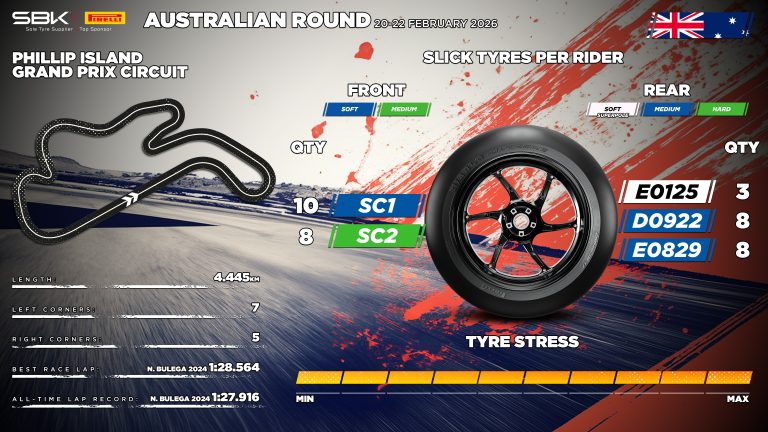
The 2026 WorldSBK season opener at Phillip Island is shaping up to be as much a battle of chemical engineering as it is of rider skill. Pirelli has arrived in Australia with a high-stakes tyre allocation centered around the debut of the SC1 medium development rear, known as the E0829 specification.
This new solution is a direct answer to the extreme thermo-mechanical stress that the “Island” layout inflicts on a tyre’s carcass, particularly through the high-speed, sustained left-hand sweepers that lead onto the main straight.
Historically, Phillip Island is notorious for “killing” tyres. The 2024 and 2025 seasons were particularly brutal due to a resurfaced asphalt that was record-breakingly grippy but exceptionally abrasive. Data from those years showed that internal tyre temperatures on the left shoulder could reach levels never before recorded, leading to mandatory mid-race pit stops because no tyre could safely complete a full race distance. The new E0829 rear utilizes the same compound as the D0922 reference tyre but introduces a revised internal structure designed to improve stability. The goal is to eliminate the performance “cliff” where lap times traditionally plummet by over a second per lap once the tyre’s structure begins to fatigue under load.
In the World Supersport (WorldSSP) category, Pirelli is implementing an even more radical technical shift. For the first time, Supersport riders will adopt the larger tyre dimensions usually reserved for the WorldSBK class, moving to a 200/65 rear and having the option of a 125/70 front. From an analytical perspective, this is a play for better thermal management. A larger footprint increases the heat exchange surface with the asphalt, effectively acting like a bigger radiator for the tyre. By spreading the load across a wider contact patch, Pirelli hopes to reduce the risk of overheating—a phenomenon that has historically seen Supersport lap times fluctuate wildly as the track temperature rises toward 50°C.
The strategic landscape for the weekend is further complicated by the inclusion of the E0125 soft development tyre, restricted exclusively to practice and Superpole. While this “qualifying” rubber allowed Nicolò Bulega to dominate pre-season testing with a blistering 1’28.630, it offers no insight into race durability. The real test will be whether the structural changes to the E0829 medium can sustain that pace over 20+ laps. As riders weigh the agile turn-in of the standard 120/70 front against the “planted” stability of the larger 125/70 option, the 2026 opener will be a definitive test of whether Pirelli has finally solved the Phillip Island puzzle.